
When snow and ice set in, having the right equipment can make all the difference. But with metal chains, front chains, fabric tire socks, and hybrid systems to choose from, it’s not always easy to know which option to go with.
Snow chains or snow socks? The best choice depends mainly on the conditions in which you drive, how often you use them, and whether they’re compatible with your vehicle.
Here are the factors to consider when choosing your winter gear.
Snow Chains or Snow Socks: The Differences at a Glance
| Criterion | Snow Chains | Snow socks |
| Heavy snow | ⭐⭐⭐ | ⭐⭐ |
| Black ice | ⭐⭐⭐ | ⭐⭐ |
| Ease of installation | ⭐⭐ | ⭐⭐⭐ |
| Durability | ⭐⭐⭐ | ⭐ |
| Driving comfort | ⭐⭐ | ⭐⭐⭐ |
| Space taken up in the trunk | ⭐⭐ | ⭐⭐⭐ |
| Regular use in the mountains | Best choice | Occasional |
In summary: For difficult conditions, mountain roads, or frequent use, snow chains are generally the most durable choice. For occasional use and when ease of installation is a priority, snow socks are particularly convenient.
When should you choose channels?
Snow chains are particularly useful when conditions become difficult: heavy snow, heavily snow-covered roads, ice, or steep slopes.
Their tread complements the tire’s performance to improve traction.
Metal chains are also generally more durable than fabric snow socks. They are therefore an attractive option for drivers who regularly travel to the mountains or who want equipment capable of withstanding harsh winter conditions.
The Benefits of Snow Chains
- Excellent traction on snow and ice
- Good wear resistance
- Designed for harsh winter conditions
- Several technologies are available, depending on the vehicle and the level of convenience desired
The main drawback of traditional chains is still their assembly, which requires more handling than a textile sock.
That is why it is strongly recommended that you set up your gear at home before heading to the mountains.
What are the different types of snow chains?
Not all channels work the same way.
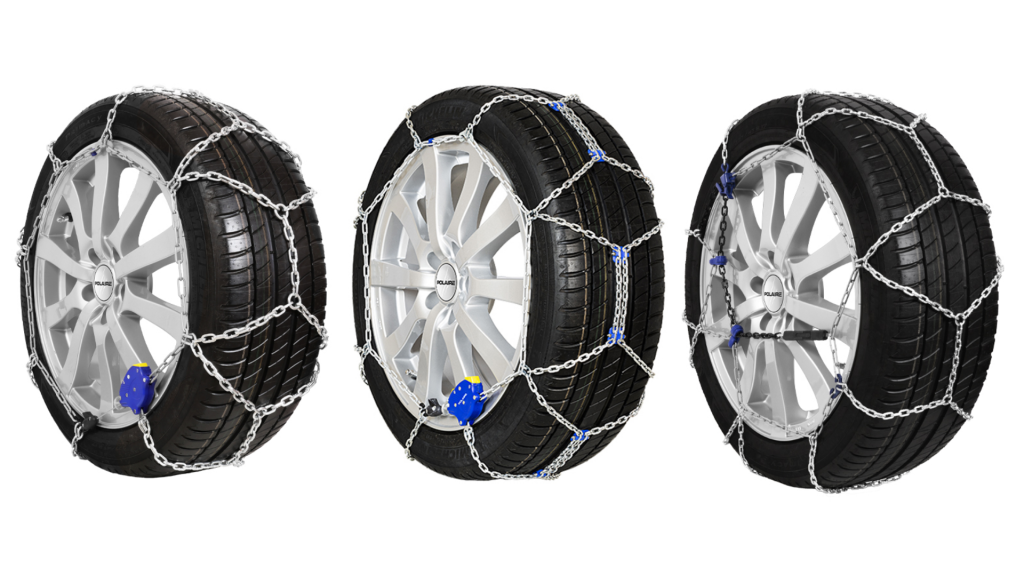
Traditional TV networks
Traditional metal chains wrap around the tire and go behind the wheel.
They are generally a cost-effective and high-performance solution. Depending on the model, the tension can be adjusted manually or automatically.
Manually tensioned chains must be checked after traveling a short distance to ensure that they are properly positioned.
Self-tensioning chains
The tensioning system allows the chain to center itself and adjust while riding.
As a result, they offer greater ease of installation and eliminate the need for certain retensioning steps required with simpler models.
Front-mount chains
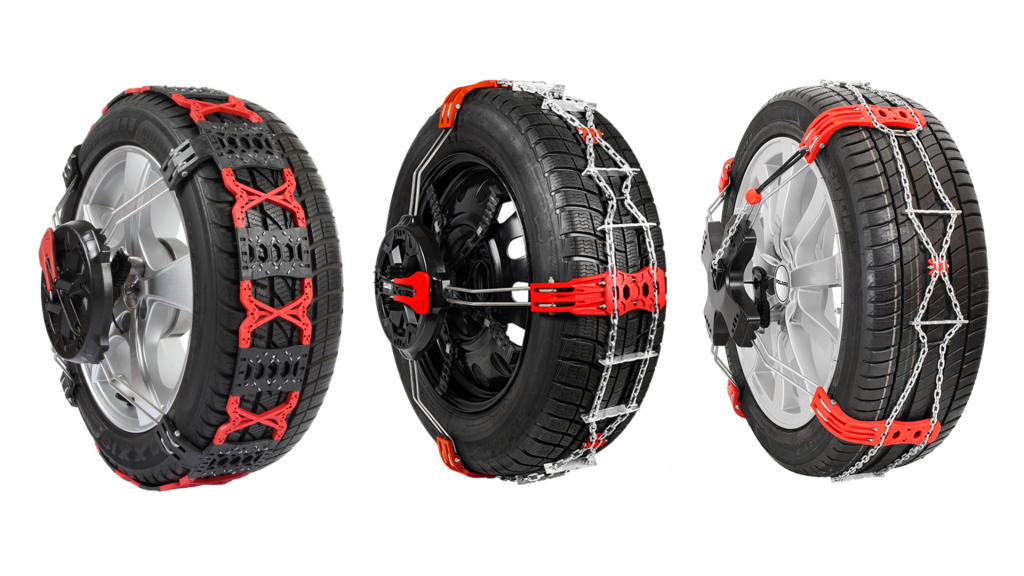
Front chains are installed from the outside of the wheel and do not require the chain to be threaded behind the tire.
They are particularly useful when there is limited space between the tire and the vehicle’s mechanical components.
The Polaire Grip, for example, features a front-mounted design with a 0 mm inner tread. It is specifically designed for use on vehicles that are not compatible with traditional snow chains, provided that the exact compatibility of the vehicle and the tires is verified.
When should you choose snow socks?
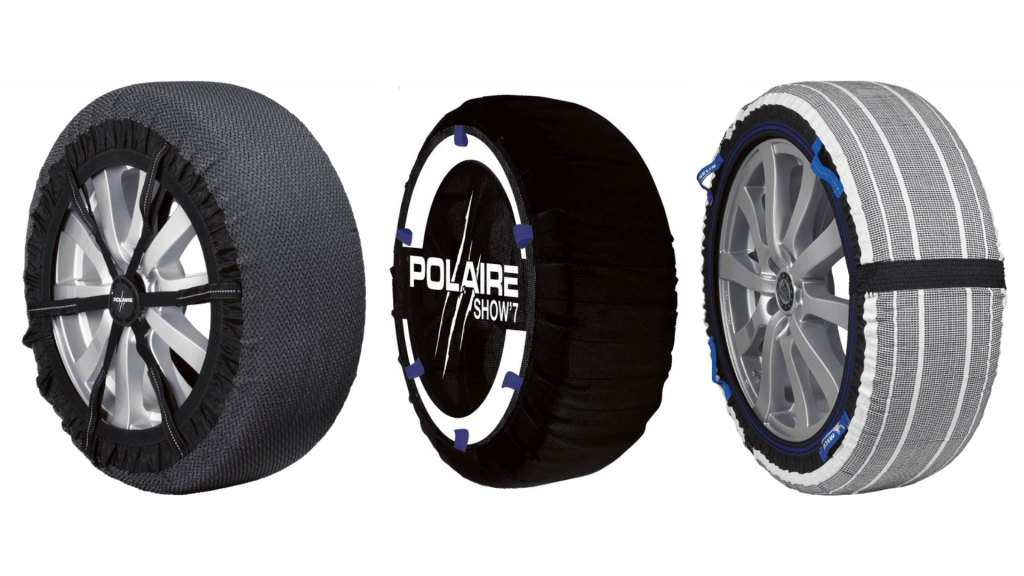
Snow socks are designed to cover the tire’s tread with a fabric sleeve.
Their main advantage is their simplicity.
Lightweight and compact, they fit easily in the trunk and can be set up quickly when a road starts to get snowy.
They are particularly well-suited for:
- for drivers who occasionally encounter snow;
- one-time trips to a ski resort;
- for drivers who prioritize ease of installation;
- for those who want to carry compact equipment in their vehicle.
They also generally run more quietly than a metal chain.
What are the limitations of snow socks?
Socks are less resistant to abrasion than a metal chain.
It is therefore particularly important to remove them as soon as there is no longer enough snow on the road. Driving on bare pavement causes them to wear out much more quickly.
In difficult conditions, particularly on deep fresh snow or ice, metal chains can also provide better traction.
The sock is therefore particularly well-suited for occasional use, while a metal or hybrid chain is generally better suited for regular use in the mountains.
What about hybrid or composite channels?
Today, there are several intermediate solutions between traditional metal chains and textile socks.
Their goal: to combine ease of assembly, a compact design, and high performance on snow.
At Polaire, several technologies follow this approach.
Polaire Steel Sock
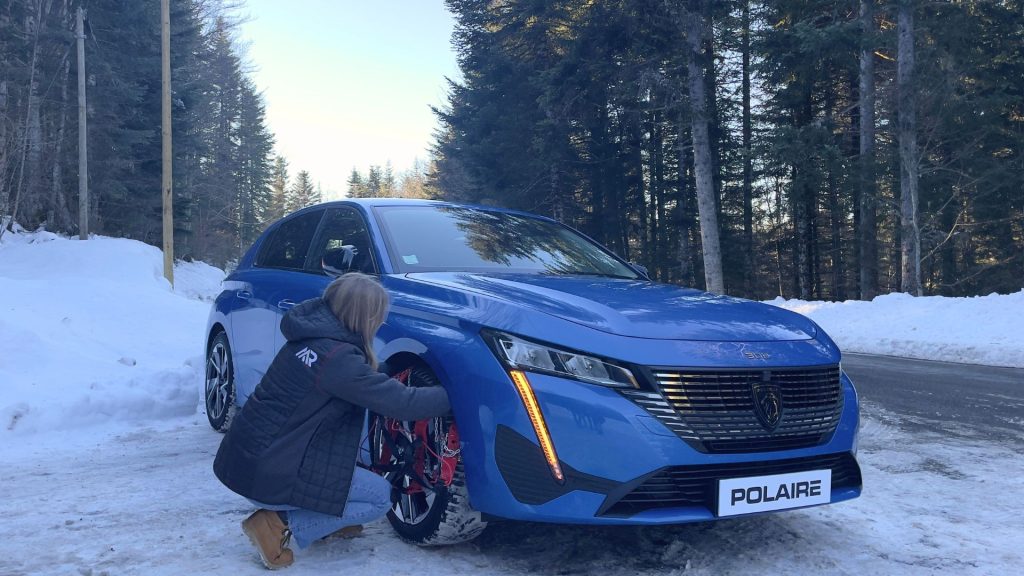
The Polaire Steel Sock combines a wrap-around construction with a tread featuring metal elements.
It offers an attractive solution for drivers who want an easy installation while still retaining the features of a stereo system.
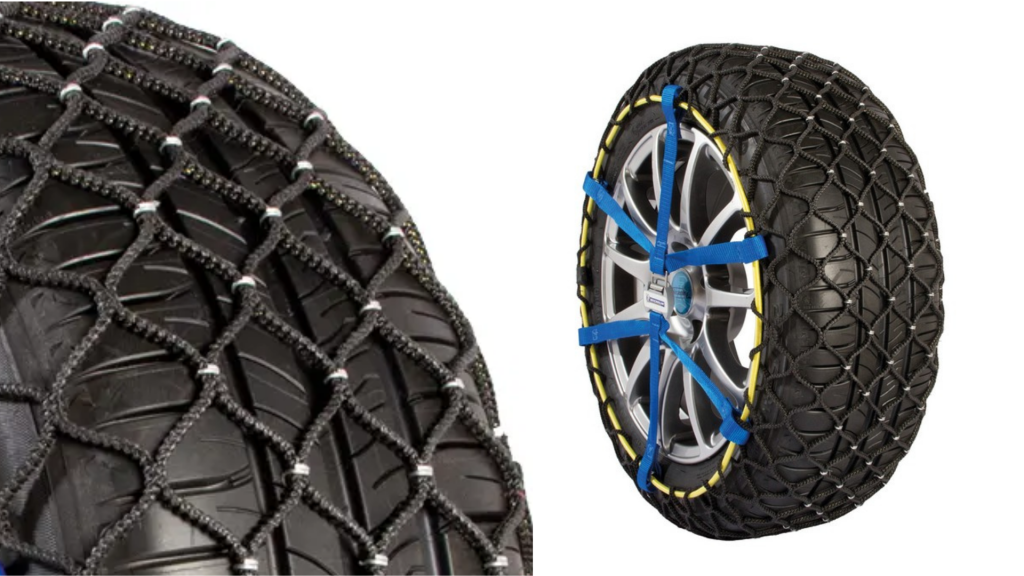
Easy Grip Evo
The Easy Grip Evo features a composite structure combined with metal elements in the tread.
It stands out in particular for its light weight, simple installation, and quieter operation compared to a traditional metal chain.
These solutions can therefore offer an attractive compromise between a traditional chain and a textile sleeve.
How do you choose the right size of chains or socks?
You don’t choose a chain or a sock based solely on the car model.
Start by noting the size indicated on the sidewall of the tire.
For example:
205/55 R16
These three values help you identify the equipment that is compatible with your tire.
Next, check the vehicle manufacturer’s recommendations, particularly regarding the available space around the wheel.
To avoid mistakes, use the Polaire configurator to identify the equipment that is compatible with your vehicle and tires.
On which wheels should the chains or tire covers be installed?
Anti-skid devices must be installed on the drive wheels at a minimum.
On a front-wheel-drive vehicle, this usually refers to the front wheels.
For rear-wheel-drive or all-wheel-drive vehicles, refer to the manufacturer’s instructions for the recommended configuration. Specifications may vary by vehicle.
Our Tips Before Heading to the Mountains
Don’t wait until you’re stranded in the snow to figure out how to set up your gear.
Before you leave:
- Check the size of your tires.
- Check whether your belts or socks are compatible.
- Do at least one dry run at home.
- Keep your gear easily accessible in the trunk.
- Be sure to bring a pair of gloves and a flashlight.
- Please review the assembly instructions.
- Remove the equipment when conditions no longer require its use.
Once the chains or snow socks are installed, drive smoothly, avoid sudden acceleration and braking, and always observe the maximum speed specified by the manufacturer.
So, snow chains or snow socks?
The choice depends primarily on how you plan to use it.
Do you regularly go to the mountains or have to deal with difficult conditions?
Choose a metal, automatic, or front-mounted snow chain that’s right for your vehicle.
Do you go skiing occasionally and are you mainly looking for a solution that’s easy to install?
A fabric sock could be the perfect solution for you.
Does your vehicle have limited space behind the wheel?
Start by looking at space-saving or front-mount solutions that are compatible with your vehicle.
Are you looking for a balance between ease of assembly and performance?
A hybrid or composite solution may be particularly appealing.
In any case, the best equipment is the kind that is compatible with your vehicle, suited to the conditions you’ll encounter, and that you know how to install properly.