
Installing traditional snow chains can be difficult when there is limited space between the tire and the wheel well. On some newer vehicles—such as SUVs, sports cars, or models equipped with large rims—the manufacturer may even restrict the use of conventional chains.
It is precisely in this context that the front-mounted snow chain really comes into its own.
Unlike a traditional chain, it is mounted primarily on the outside of the wheel and does not require a cable or chain to be routed behind the tire.
The result: an easier installation process and a solution that is particularly well-suited to many vehicles considered “non-chainable,” provided their compatibility is verified.
What is a front-mounted snow chain?
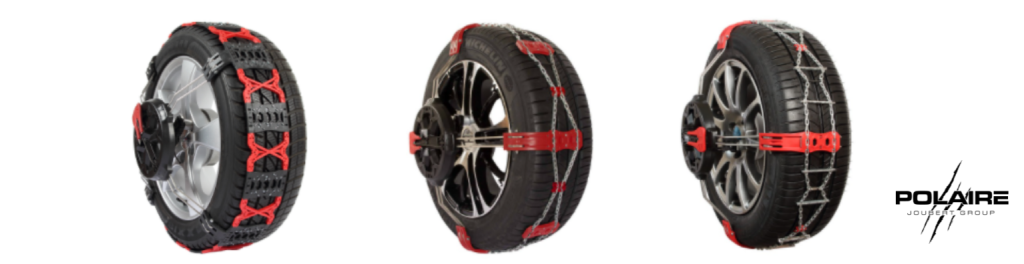
A front chain is an anti-skid device whose mounting system is installed from the outside of the wheel.
Once secured, its structure gradually settles into place on the tire’s tread.
The main difference between it and a traditional chain is therefore the way it runs behind the wheel.
On a conventional chain, a cable or locking mechanism usually has to be positioned behind the tire. With a suitable front chain Polaire, there may be no space required on the inside.
The Polaire Grip, for example, has an inner tread depth of 0 mm and an outer thickness of 7 mm.
Why are some vehicles considered “not suitable for chaining”?
The term “not chainable” does not necessarily mean that no snow equipment can be installed.
It generally indicates that there is not enough space behind the wheel to use a traditional chain.
Several mechanical components may be located very close to the tire:
- shock absorber;
- suspension;
- brake hose;
- wheel well;
- sensors;
- steering components.
An ill-fitting standard chain could come into contact with these components.
That is why some manufacturers prohibit or restrict the use of traditional tire chains on certain tire sizes.
A front chain can be an alternative, since it avoids clutter behind the wheel.
Please note: A vehicle listed as “not chain-compatible” is not automatically compatible with all front chains. Always check the manufacturer’s recommendations and verify the specific compatibility between the vehicle, the tire size, and the selected chain.
What are the advantages of a front-mounted snow chain?
1. Do not walk behind the wheel
That’s its main advantage.
Installation is done from the outside, which eliminates the need to reach behind the tire.
This design also makes it possible to install the system in certain vehicles with very little space between the wheel and the mechanical components.
2. A more accessible setup
Installing a traditional snow chain on the side of a snow-covered road isn’t always easy.
The front chain is designed to make this task easier.
Once the initial adjustment has been made, some Polaire systems allow for quick installation. The Polaire Grip and the Steel Grip, in particular, claim an installation time of about 2 minutes.
Of course, this depends on the user and the conditions under which the installation is carried out.
3. Automatic tensioning and centering
On several front chains Polaire, tensioning and centering occur automatically during operation.
Therefore, it is not necessary to perform the same retensioning procedures as with some traditional chains.
In particular, the Polaire Grip uses an X-shaped structure that allows the equipment to adjust to the tire.
4. Good traction on snow and ice
A front chain is, first and foremost, a snow chain.
Depending on the model, the tread combines metal components, composite materials, or polyurethane to improve traction and grip.
For example, the Polaire Grip uses a polyurethane tread with metal inserts designed to improve traction on ice.
| Criterion | Front chain | Traditional chain |
| Runs behind the wheel | No or very limited | Yes |
| Vehicle with limited wheel clearance | Depends on compatibility | ⚠️ Often problematic |
| Ease of installation | ⭐⭐⭐ | ⭐⭐ |
| Automatic tension | Often depends on the model | Depends on the model |
| Size | Small indoors | Varies |
| Price | Generally higher | Generally more affordable |
| Occasional use | ✅ | ✅ |
| Frequent use in the mountains | ✅ | ✅ |
The choice therefore depends as much on the vehicle as it does on how you use it.
If your car is fully compatible with traditional snow chains and you’re primarily looking for an affordable solution for occasional use, a standard snow chain may be sufficient.
On the other hand, for a vehicle with a narrow wheel well or if you prefer an easy installation, a front chain may be a particularly good option.
How do you install a front snow chain?
The exact operation depends on the model, but the general principle remains the same.
Step 1: Prepare the chain
Before using it for the first time, follow the instructions in the manual to adjust it to your tire size.
Do not make this initial adjustment on the side of a snow-covered road.
Step 2: Attach the system to the wheel
The chain is secured from the outside using the system provided by the manufacturer.
On the Polaire Grip, a universal nut allows it to be attached to the wheel, among other things.
Step 3: Position the chain
Place the frame around the accessible part of the tire according to the instructions.
Step 4: Ride a few meters
The system gradually positions itself on the tire.
On models with automatic tension, the chain centers itself and adjusts its tension as it moves.
Step 5: Check the assembly
After a few meters, visually check that the equipment is properly positioned.
Next, observe the maximum speed specified in your stereo system’s manual.
Which front chainring Polaire should I choose?
The Polaire product line now includes several front-end solutions designed for different uses.
Polaire Grip
The Polaire Grip is particularly well-suited for vehicles with limited space behind the wheel.
In particular, it has:
- a front-mounted assembly;
- with an internal clearance of 0 mm;
- automatic centering;
- an automatic voltage regulator;
- an X-shaped structure;
- with an estimated assembly time of 2 minutes after adjustment.
It complies with the EN 16662-1 standard and is listed as B26-compatible.
Polaire Steel Grip
The Polaire Steel Grip uses the front-mount design with a metal tread that is particularly well-suited for situations where durability and traction are needed.
It also features a zero internal footprint, automatic tensioning, and quick installation once adjusted.
Polaire Grip One
The Polaire Grip One is another front-end solution designed specifically for vehicles with a narrow wheelbase.
It combines polyurethane pads, metal links, and a self-tensioning system. Its internal profile is also listed as 0 mm.
Polaire Spider Grip
Spider Grip solutions are designed specifically for certain utility vehicles and configurations with steel wheels.
The choice therefore depends heavily on the type of vehicle and its specifications.
Are front chains approved under the Mountain Law?
Yes, provided that you choose equipment that meets the applicable regulatory requirements.
Several head straps Polaire are certified to EN 16662-1 and are B26-compatible. This includes the Polaire Grip, the Steel Grip, and the Grip One.
In areas covered by the Mountain Law, they may thus be used as part of removable anti-skid devices designed for use on drive wheels.
However, compatibility with your vehicle is still essential.
How do I choose the right size?
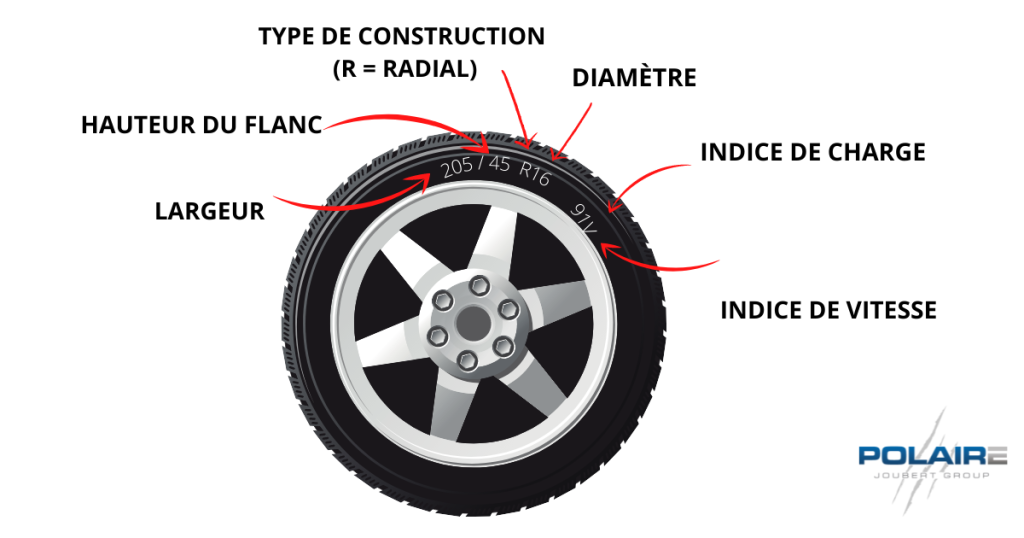
A snow chain must match the exact size of your tires.
This dimension is marked on their side.
For example:
225/45 R18
Next, you need to check:
- the vehicle’s make and model;
- its engine type and, if applicable, its model year;
- the exact size of the tires;
- the manufacturer’s recommendations;
- the compatibility indicated by Polaire.
Two vehicles equipped with tires of the same size may have different stresses in the wheel well.
Therefore, you should not choose a tire based solely on its size.
When should you choose a front chain?
A front-mounted snow chain is particularly useful if:
Your vehicle is listed as incompatible with standard
snow chains → a compatible front-mounted solution may help overcome the lack of space behind the wheel.
Large rims and limited space in the wheel
wells → minimal or no interior bulk becomes a major advantage.
If you go to the mountains
regularly → the simplified setup can be a real plus when you plan to use the equipment several times during the season.
Above all, you’re looking for an easy-to-install
setup → not having to deal with a cable behind the wheel makes installation much easier.
Before you go: always do a test run
Even with a front chain designed to be easy to install, practice installing it before you set out.
Set it up for the first time at your own pace at home, make sure you understand how the mounting system works, and keep the instruction manual in the carrying case.
On the day you need to put your snow chains on, you’ll save valuable time.
Key Takeaways
A front snow chain combines traction on snow, a compact design behind the wheel, and ease of installation.
It is particularly useful for vehicles with a narrow wheel well or those that are not compatible with traditional snow chains.
But the key criterion remains the same: choose a set of chains that are explicitly compatible with your vehicle and tires.