
Now that the Mountain Law has gone into effect, snow chains and snow socks are more in demand than ever. Traditional chains, front-wheel chains, snow socks… Every car is unique and requires the right equipment.
But where did this equipment—which has become mandatory these days—come from??
The Story
Traditional snow chains were first developed in North America, in the state of New York. Before this equipment was introduced, drivers used a system of hemp ropes (an effective but not durable solution).
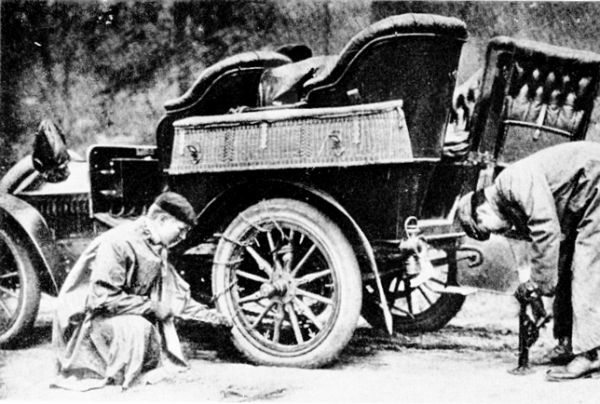
Source: autos-motos.fr
In 1904, Harold D. Weed designed the first metal snow chains, the “Grip-Tread for Pneumatic Tires.”
A patent describes these chains as “easy to handle and fold.” To install these early snow chains, you must first partially deflate the tire. Next, secure the chains using hooks before reinflating the tire. This method ensures that the chains stay securely in place.
In those early days of the automobile, there weren’t many cars yet, and people generally traveled by horse-drawn carriages or sleighs. Country roads were difficult to navigate in winter, which contributed to the great success of this innovation.
The Beginning of Success
It was during the New York to Paris race that the first set of snow chains, designed by Harold D. Weed, was introduced to the general public. The Thomas Flyer car, equipped with Weed chains, won the race.
But the media coverage didn’t stop there… A short time later, during his show, a performer named Houdini handcuffed himself and wrapped himself in eight Weed chains from head to toe—a total of 181 kg of steel. After about thirty minutes, he managed to free himself, to the astonishment and applause of the audience.
This is how the Weed by Harry D. Weed chains are marketed to the general public, and they go on to become a huge success. The chains are designed for use in both snow and mud.
TV Channels Today
Since the days of Harry Weed’s "Weed" chains, snow chains have come a long way. In particular, snow socks have been available since 2000.
We offer a wide range of winter equipment for both individuals and professionals: traditional snow chains, front-mount snow chains, snow socks, hybrid snow chains, and snow chains for heavy-duty trucks.
Each set of chains has different characteristics (tire size, vehicle type, intended use), and every vehicle is different: that is why it is very important to make sure your vehicle is compatible with a specific model.
Snow chains have become an essential piece of equipment to have in your vehicle from November 1 through March 31 (see the article on the Mountain Law II).
There are 4 types of snow chains, depending on your vehicle and how you plan to use them:
Manually tensioned chains: that is, traditional snow chains—easy to install, but the process can be time-consuming / an affordable option for occasional use (for example, our XP9 and XP16 models)
Self-tensioning chains: They can be installed very quickly, and the process is automatic.
"Spider" chains are recognizable by their "octopus"-like shape, which wraps around the tire. Thanks to their quick and easy installation, they offer a practical solution for everyday use, just like our Polaire Steel Sock.
Front chains, on the other hand, attach directly to the outer surface of the tire. Their mounting system simplifies installation, making them ideal for regular use, such as our Polaire Grip.
There are two main types of snow socks:
Textile snow socks: These are the most well-known—they’re quick and easy to put on. There are several types of snow socks made from fabrics of varying durability. (For example, our models: TyreEffect, Show7)
Mesh snow socks: Visually, they can be mistaken for snow chains—which is why they’re also called “textile snow chains.” Their composite mesh provides excellent traction in snow or ice (for example, our EasyGrip model).
Visit our website Polaire to see all our models.