
Every winter, the B58, B59, and B26 signs reappear on mountain roads. But what exactly do they mean? Are snow chains required? Are winter tires enough? And how can you tell if you’re entering an area covered by the Mountain Law?
Since 2021, specific signage has been used to identify areas where winter equipment is required.
Here’s how to recognize these signs and choose the right equipment before hitting the road.
The Mountain Act: Key Takeaways
From November 1 through March 31, in certain municipalities located in mountainous areas, eligible vehicles must be equipped with winter driving gear.
For a passenger car, light commercial vehicle, or motorhome, there are two main options:
- equip your vehicle with 4 3PMSF winter tires;
- or have suitable removable anti-skid devices that can be fitted to at least two drive wheels.
These devices may, in particular, take the form of chains or equivalent anti-skid equipment that meets regulatory requirements.
Please note: As of November 1, 2024, tires bearing only the M+S marking are no longer sufficient to meet the requirement. To comply with the Mountain Law, winter tires must, in particular, bear the 3PMSF alpine symbol.
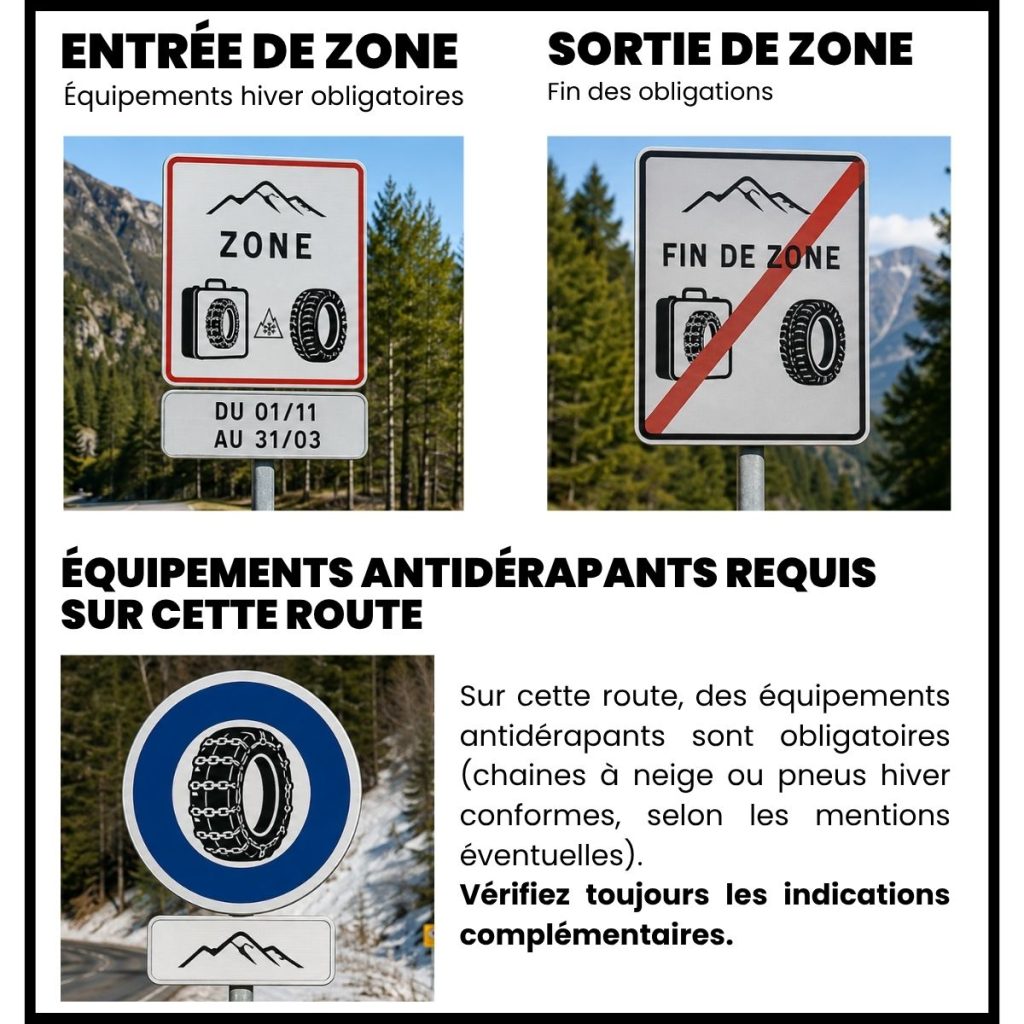
What does the B58 sign mean?
Sign B58 indicates the entrance to an area where winter equipment requirements apply.
You can recognize this sign by its rectangular shape and its pictograms depicting a mountain and winter gear.
A sign usually specifies the time period in question:
FROM NOVEMBER 1 TO MARCH 31
Therefore, starting at sign B58, the vehicles in question must comply with the rules set forth in the Mountain Law during this period.
These signs are important: they inform drivers that they are entering a restricted area.
What does the B58 sign mean?
Sign B59 marks the exit from the area where winter equipment is required.
It incorporates the design elements of the B58, with a diagonal bar indicating the end of the prescription.
In practice:
B58 = entry into the restricted
area B59 = exit from the restricted area
Please note, however, that leaving a B58 zone does not eliminate other weather-related requirements. For example, a B26 sign may require certain equipment on a snow-covered road.
What is the difference between sign B58 and sign B26?
This is a common misunderstanding.
Sign B58 designates an area where winter equipment is required from November 1 through March 31.
Sign B26, for its part, indicates a traffic requirement on a road where conditions necessitate the use of traction-enhancing equipment.
Specifically, this sign means that snow chains are required on at least two drive wheels.
For certain categories of vehicles, winter tires that meet regulatory requirements may be accepted as fulfilling this requirement.
However, when a sign or notice states “snow chains required,” the use of snow chains is specifically required.
It is therefore essential to look not only at the sign, but also at the accompanying instructions.
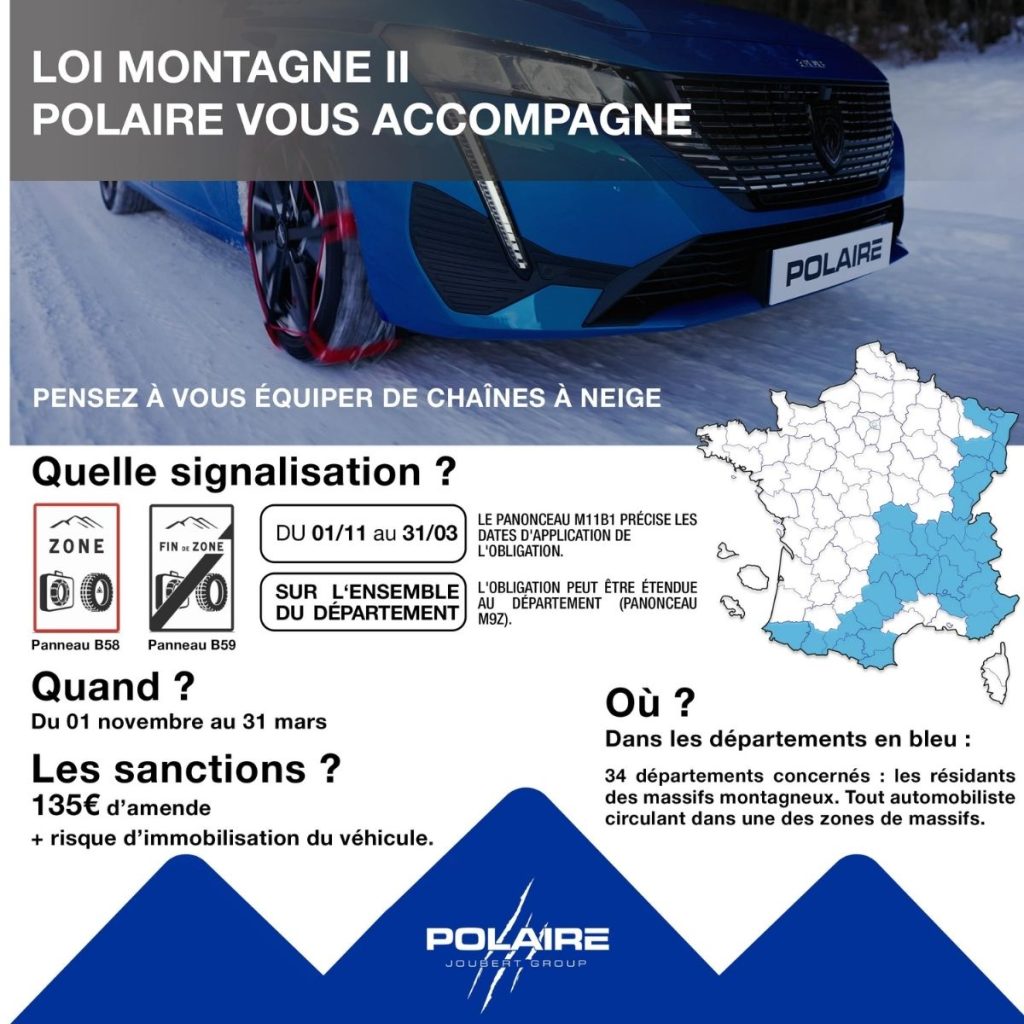
Where does the Mountain Act apply?
The Mountain Law does not automatically apply to all roads in a mountainous department.
The prefects of 34 departments determine the municipalities in which the requirement applies.
A single zone may therefore cover an entire municipality, several municipalities, or specific routes, with the option to grant exemptions on certain roads.
The best way to find out if your route is affected is to:
- check the information provided by the prefecture of the department you are traveling through;
- check the official list of affected municipalities;
- Keep an eye out for the B58 and B59 signs along the road.
If you’re heading to the mountains, it’s best to check this before you leave rather than once you’ve arrived in the restricted area.
Which vehicles are affected?
The requirement applies to vehicles with four or more wheels, with rules that vary depending on their category.
Passenger cars, light commercial vehicles, and motorhomes
They must:
- or have removable anti-skid devices that can be fitted to at least two drive wheels;
- or be equipped with four compliant winter tires.
Tour buses, city buses, and heavy trucks without trailers
They also have a choice among the winter equipment required by regulation.
Heavy-duty trucks with trailers or semi-trailers
They must have removable anti-skid devices that can be fitted to at least two drive wheels, even when equipped with winter tires.
Special provisions apply to vehicles equipped with studded tires.
M+S or 3PMSF Tires: What’s the Difference Under the Mountain Law?
This is one of the major changes since the regulations were first published.
Until October 31, 2024, certain tires bearing only the M+S marking were permitted during a transitional period.
That is no longer the case.
To be considered winter tires under the Mountain Law, tires must bear the 3PMSF mountain symbol—recognizable by a three-peaked mountain containing a snowflake—along with the markings required by regulation.
A tire marked only with "M+S" may still be used, but this does not exempt the driver from having the required anti-skid devices in the relevant areas.
Snow chains or snow socks: What should you keep in the trunk?
If you are not driving with four 3PMSF-compliant tires, you must have removable traction devices that are suitable for your vehicle and can be installed on at least two drive wheels.
Before purchasing your equipment, check the following:
- the exact size of your tires;
- the automaker’s recommendations;
- the available space in the wheel well;
- whether the equipment is compatible with your vehicle;
- its compliance with applicable regulations.
Not all vehicles can accommodate a traditional chain. On some models with narrow wheel wells, a space-saving or front-mount solution may be necessary.
What are the penalties for violating the Mountain Act?
Driving in a restricted area without the required equipment may result in a fixed fine of €135.
Law enforcement officers may also prevent a vehicle that is inadequately equipped from continuing on its way when traffic conditions so require.
Beyond the penalty, the main purpose of the regulation is to prevent a vehicle that has become stuck on a snow-covered road from endangering its occupants, other road users, or emergency responders.
Get Ready for the Mountain Act with Polaire
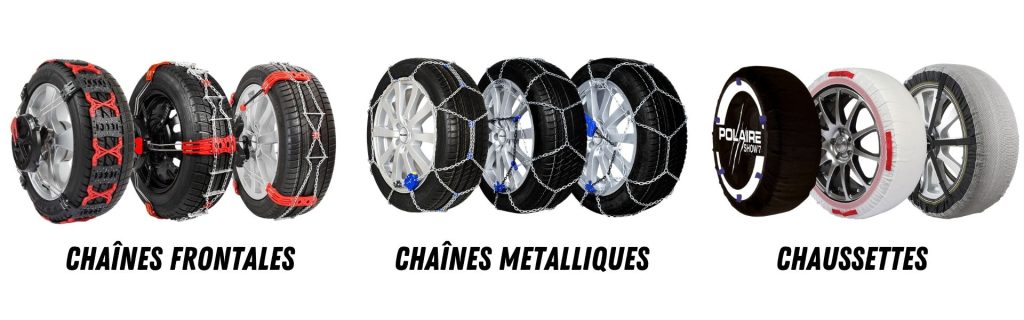
Polaire offers a variety of anti-skid solutions designed for vehicles and winter conditions: metal chains, front chains, hybrid systems, and textile solutions.
Your choice shouldn’t be based solely on price or ease of installation. Compatibility with the vehicle and tire size are essential.
To find the right equipment, use the Polaire configurator by entering your vehicle or tire dimensions.
Key Takeaways
Sign B58 indicates the entrance to an area where winter equipment is required, while sign B59 indicates the exit from that area.
B26 refers to a specific requirement regarding anti-slip surfaces and should not be confused with the zone-based signage requirements of the Mountain Act.
Between November 1 and March 31, if your route takes you through an affected area, be prepared: check your tires, your equipment, and its compatibility before hitting the road.