
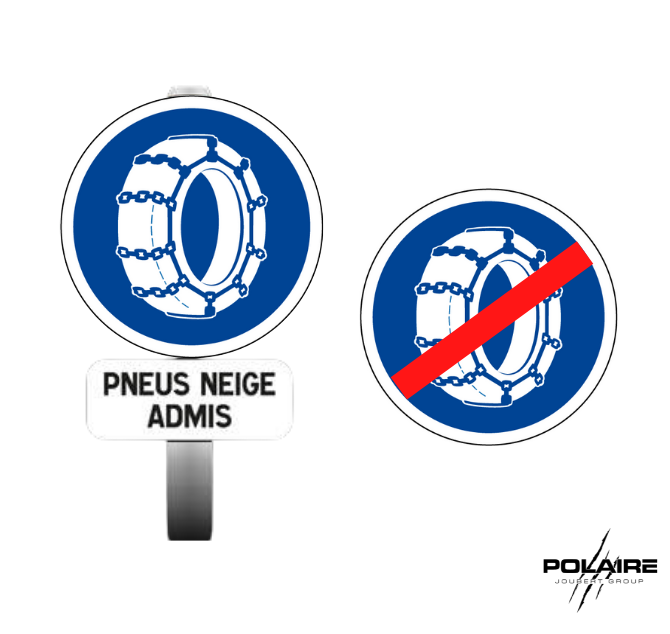
A sign we often see in mountainous areas—such as near ski resorts or close to a mountain pass—the B26 sign reminds us to use equipment suitable for mountain conditions.
In fact, it informs us of the locations where the use of snow chains or snow socks on vehicles with at least two driven wheels is mandatory. Sometimes, an M9 sign with various instructions specifies that snow tires are permitted. In the absence of this sign, snow tires are under no circumstances a substitute for chains!
Sign B44, which is marked with a crossed-out snow chain, indicates that the requirement no longer applies.
For your safety, it is essential to follow this guideline and adjust your driving when your snow chains are installed. Be sure not to drive faster than 50 km/h to avoid damaging your snow chains, tires, and the vehicle’s steering components. Also, be careful not to start, accelerate, or brake abruptly.
Packing a headlamp, a pair of gloves, and a snow shovel before you leave can be very helpful if you need to pull over to the side of the road to put on your snow chains—keep that in mind! To give yourself peace of mind and save time, practice putting on the snow chains before you leave.
Of course, you’ll need to make sure you have the right equipment for your vehicle, since snow chains aren’t compatible with all tires. So choose a size that fits your tires and verify that the snow chains or snow socks are suitable for your vehicle. This precaution ensures your safety. In addition, certain mechanical components around the wheel can damage the snow socks.
To learn more, check out our article on the differences between snow chains and snow socks!
Get ready for winter now by stocking up on Polaire anti-slip gear!